Sunscreen Is Quietly Destroying Your Yoga Mat's Grip
Quick Answer: Sunscreen contains oils, silicones, and film-forming polymers designed to resist water — which means they resist your normal mat spray too. They build up as a slick, invisible layer that reduces grip and does not come off with water or a vinegar spray. You need a gentle surfactant, warm water, mechanical wiping, and often two passes. Prevent it by letting sunscreen absorb fully and by using a mat towel outdoors.
Your mat was perfect in May. It is August and your hands slide out of downward dog on a mat that looks completely clean.
Water-based cleaners cannot remove a water-resistant film — that is the entire design brief of sunscreen. The third section is what actually works.

Why does sunscreen wreck grip specifically?
Because everything that makes a sunscreen good makes it bad for a mat surface.
Sunscreens are formulated to stay on skin in water and sweat. They achieve that with film-forming polymers, silicones, and emollient oils that create a continuous water-resistant layer. Transferred onto a mat, that layer does exactly what it was designed to do: it stays put and repels water.
Mat grip works through friction and surface texture. Most mats rely on a slightly tacky polymer surface, a micro-texture, or an open-cell structure that absorbs moisture. A film of silicone and oil defeats all three — it fills the texture, blocks the open cells, and replaces a tacky surface with a slick one.
Mineral sunscreens add a second problem. Zinc oxide and titanium dioxide are fine solid particles. They lodge in mat texture and act like a dry lubricant, and they leave a faint white haze that people mistake for wear.
Then there is accumulation. One session transfers a little. Twenty sessions across a summer transfer twenty times as much, and because the layer is transparent and thin, there is no visible cue that the mat is dirty. People conclude the mat has worn out.
Open-cell mats suffer most — the absorbent surface that normally gives excellent wet grip absorbs the sunscreen oils permanently into the top layer. Closed-cell mats like PVC and TPE fare better because the film sits on top where it can be removed.
Body lotion, self-tanner, and hair product cause the same problem, and self-tanner also stains.
Why does your usual mat spray not fix it?
Because most mat sprays are built for a different job.
A typical mat spray is water, a little alcohol, a mild antibacterial agent, and essential oils. Its job is to sanitize and to remove sweat salts. None of those components emulsify silicone or oil, so a spray-and-wipe redistributes the film rather than removing it.
Vinegar does not help either. Acid is good on mineral deposits and salt residue; it does essentially nothing to an oil and silicone layer.
And here is the part that makes it worse: many mat sprays contain essential oils, and oil-containing sprays actively contribute to buildup on some mat surfaces. If you have been spraying an oil-based cleaner all summer on top of sunscreen residue, you have been adding to the problem.
What actually removes an oily film is a surfactant — a molecule with a water-loving end and an oil-loving end, which is the entire principle of soap. Plus warm water, and mechanical action.
Two cautions before you start:
Do not use harsh degreasers or alcohol-heavy solutions on rubber or open-cell mats. They can dry out and crack natural rubber and strip the surface of TPE.
Do not soak an open-cell or natural rubber mat, and never put a mat in a washing machine unless the manufacturer explicitly says so — agitation delaminates layered mats.
Test any cleaning method on a small corner first, particularly on a natural rubber or cork mat.
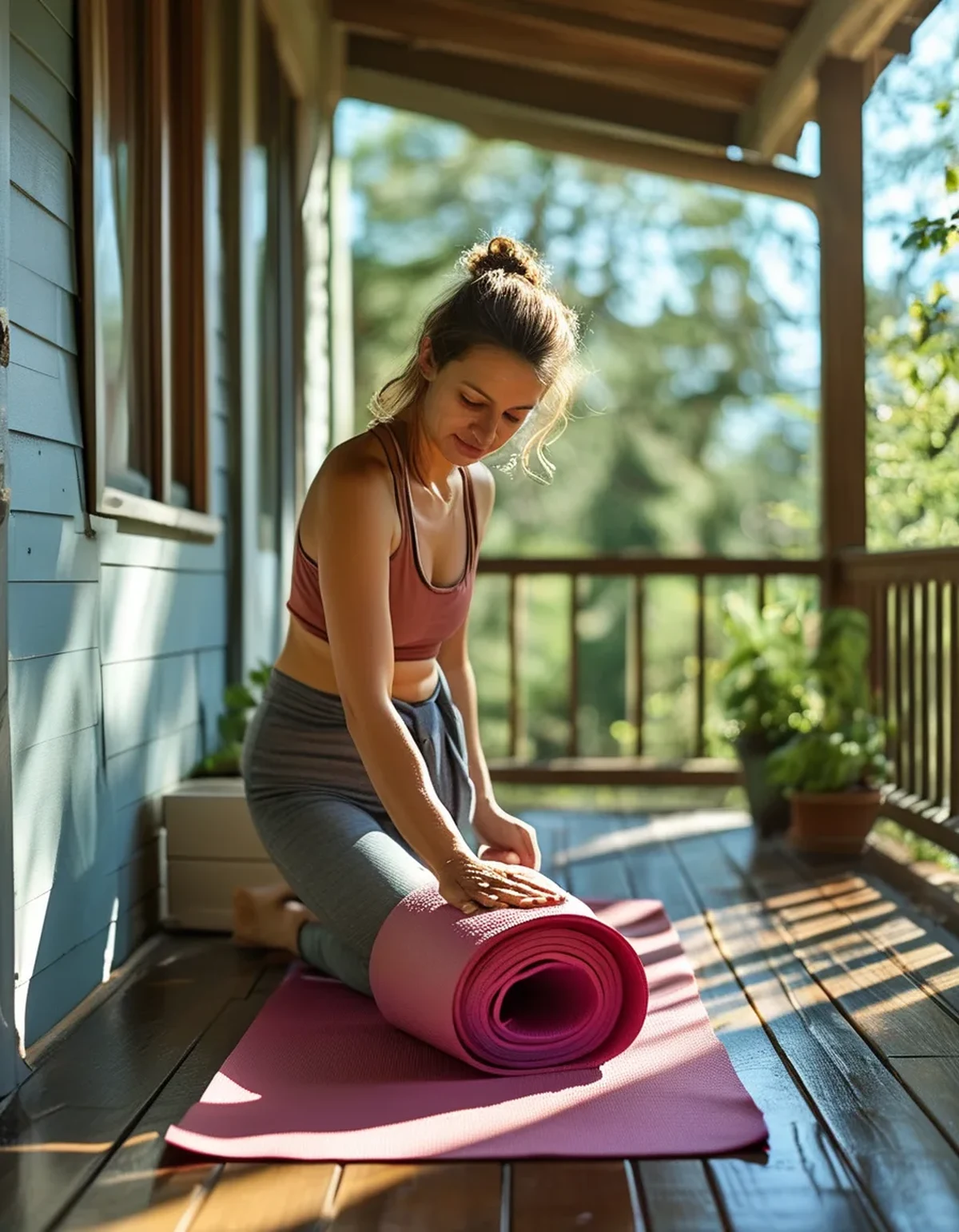
The cleaning method that actually restores grip
Roughly 20 minutes, plus drying time.
What you need: warm water, a small amount of a gentle dish soap or a mild unscented liquid soap, two microfiber cloths, and a soft brush if the mat has deep texture.
Step 1: Mix a weak solution. A few drops of dish soap in a litre of warm water. Weak is important — a strong solution leaves its own residue, which is slippery in a different way.
Step 2: Work in sections, wiping firmly. Wring the cloth so it is damp, not wet. Wipe with real pressure in one direction, then again crosswise. The mechanical action is doing at least half the work. For textured mats, a soft brush in small circles.
Step 3: Rinse properly, twice. With a clean cloth and plain water. Soap residue left behind is itself slippery — this is the step people skimp on and then conclude the cleaning did not work. Rinse, wring, rinse again.
Step 4: Repeat once on an open-cell mat. A single pass rarely gets all of a summer’s accumulation out of an absorbent surface.
Step 5: Dry completely, flat, away from direct sun. Direct sun degrades rubber and TPE, which is ironic given the cause. Flat, in shade, with airflow, until genuinely dry — several hours at least. Rolling a damp mat produces mildew.
Step 6: Test the grip with damp hands, since that is the condition that matters.
If grip is still poor after two passes: the sunscreen has likely absorbed into an open-cell surface permanently. A mat towel over the top is the practical solution — and it works very well.
Myth vs Fact: mat grip and cleaning
Myth: A slippery mat means the mat has worn out.
Fact: Most mid-summer grip loss is contamination, not wear. Genuine wear shows as visible surface change — smoothing, thinning, flaking, or loss of texture you can see and feel. An invisible, uniform slipperiness across the whole mat is a film, and films come off.
Myth: New mats are supposed to be slippery, so break it in by using it more.
Fact: New mats often have a manufacturing film, which is a real thing and does need removing — but that is a different problem with a different timeline. A mat that got slippery over a summer of use is not breaking in.
Myth: Vinegar cleans everything.
Fact: Vinegar is good on mineral haze and salts and useless on oils. Different residues need different chemistry. Sunscreen is an oil problem.
Myth: Essential oil mat sprays are the best cleaner because they are natural.
Fact: Oil-containing sprays can contribute to buildup on several mat surfaces. For routine cleaning, a plain water wipe after each use plus a periodic soap-and-water deep clean serves better.
Myth: If it is clean it should grip when wet.
Fact: Wet grip is a property of the mat’s construction. Closed-cell mats get slippery when wet no matter how clean they are; open-cell and rubber mats grip better wet. If you sweat heavily, a mat towel is the answer regardless of cleaning.
FAQ: Mat Grip Questions, Answered
How do I stop this happening next summer?
Let sunscreen absorb fully before practicing — 15 to 20 minutes is the usual recommendation for it to bind to skin anyway, which is good sun protection practice as well as good mat practice. Then use a mat towel for outdoor sessions, and wipe the mat with plain water after every outdoor practice rather than only when it looks dirty.
Is a mat towel actually as grippy as a good mat?
A damp mat towel is grippier than most mats, which is why hot yoga studios use them. The trade is that it needs to be damp to work well and it can slide on the mat underneath — look for one with silicone nubs on the underside. For anyone practicing outdoors in summer, it solves the sunscreen problem entirely by putting a washable layer between you and the mat.
Can I use a magic eraser or a scrubbing pad?
Be careful. Abrasive pads and melamine sponges physically remove surface material, which can strip the texture that provides grip and permanently damage the mat’s top layer. If a soft brush and soap have not worked in two passes, the answer is a mat towel rather than a more aggressive tool.
TL;DR:
- Sunscreen’s oils, silicones, and film formers are designed to resist water — including your water-based mat spray.
- Mineral sunscreens also leave fine particles that act like a dry lubricant in the mat’s texture.
- You need a weak soap-and-warm-water solution, firm mechanical wiping, and two plain-water rinses.
- Dry completely flat, out of direct sun, and expect a second pass on open-cell mats.
- Prevent it by letting sunscreen absorb for 15 to 20 minutes and using a mat towel outdoors.
The satisfying thing about this one is how often a mat that someone had written off comes back completely. A slippery mat feels like an expensive replacement decision, and about eighty percent of the time it is twenty minutes with dish soap and a cloth.
See It in Motion
Seen here: Bootcut Yoga Pants with Side Pockets — shop it on bubblelime.com
Keep Reading
This article is for general informational and styling purposes only. Fit, sizing, and product availability may vary.