Why Your Mat Feels Unstable on Carpet and What Fixes It
Quick Answer: Carpet makes a mat unstable because the pile compresses unevenly under uneven pressure, so your base tilts as you shift weight. It also lets the mat slide on the pile and reduces the feedback your feet use to balance. Fix it with a thin, firm mat (thick mats make it worse), a rigid board or plywood underneath for balance work, and practising near a wall while you adapt.
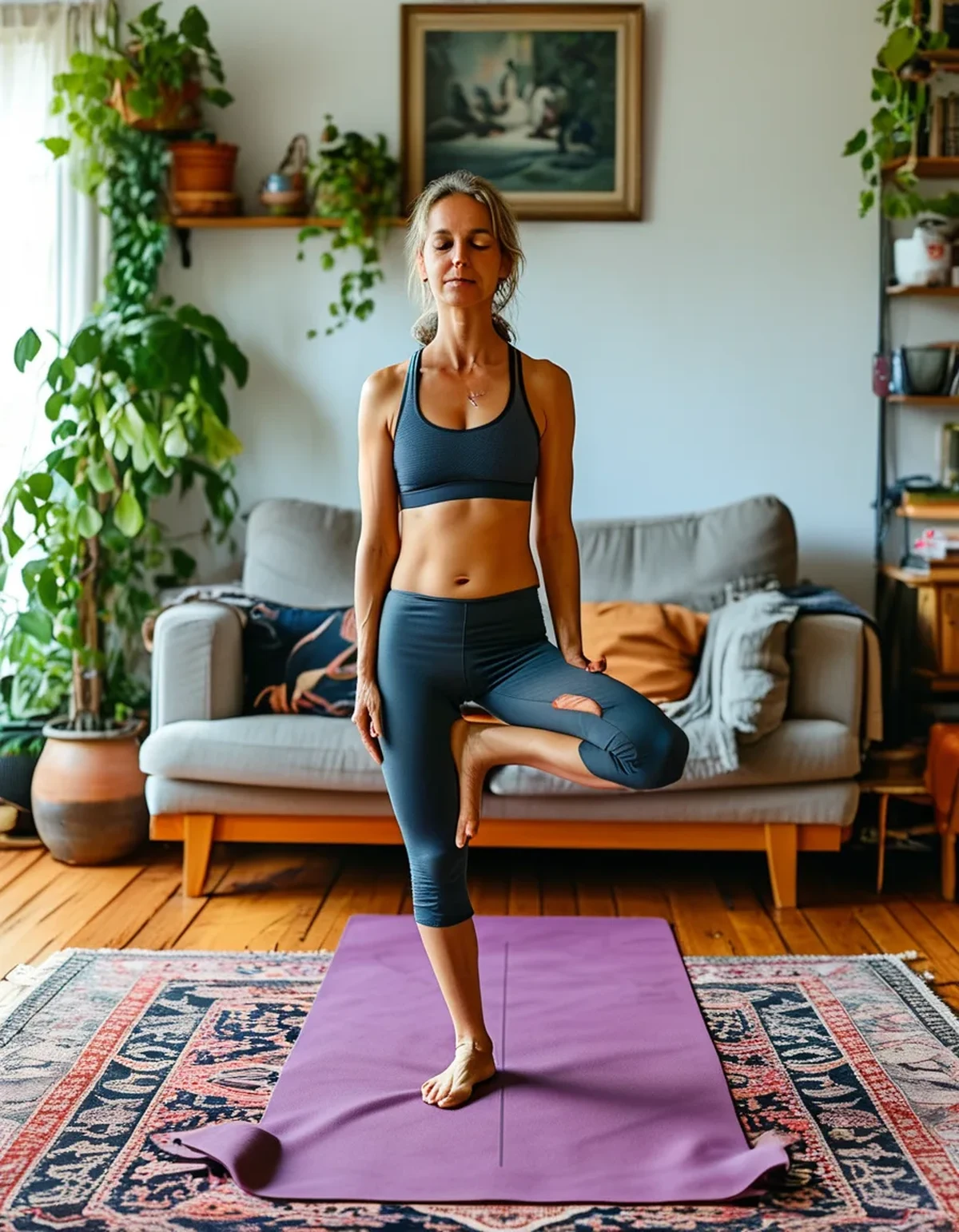
Studio: solid floor, steady tree pose.
Home: same pose, same mat, and you are hopping around the living room.
The floor moved. Literally.

Why does carpet actually destabilise you?
Four mechanisms, and they compound in exactly the poses you notice it in.
Uneven compression under uneven load. When you stand on one foot, pressure concentrates under that foot and the pile compresses there and not elsewhere. Your base tilts, you correct, the pressure moves, and the pile compresses somewhere new. This is a feedback loop, and it is why the wobble builds rather than settles.
Reduced proprioceptive feedback. Balance relies heavily on pressure information from the soles of your feet. A soft surface blurs that signal — the same reason standing on a foam pad is a standard balance-training progression. Carpet is an unintentional balance challenge, which is fine if you know that is what you signed up for.
The mat slides on the pile. A mat grips a hard floor through friction. On carpet, especially a longer pile, the mat can shift across the top of it — most obviously in downward dog and lunges, where you feel the front of the mat creep forward.
And thick mats make it worse, not better. A cushioned mat plus a compressible carpet is two layers of instability. The instinct to add padding is exactly backwards here.
What actually fixes it?
Five options, ordered by effectiveness for balance work.
Put something rigid underneath. A piece of plywood, a large chopping board, a hardboard panel, or a folded thin exercise mat with a hard surface. This is the complete fix — it gives you a genuinely solid base and it costs very little. Even a modest board under the standing foot area transforms balance poses.
Use a thinner, firmer mat. 3mm rather than 6mm, and dense rather than plush. The thinner the mat, the more directly you are on whatever is underneath, and the less the mat itself contributes to the wobble.
Choose a mat with a grippy underside. Some mats have a textured lower surface specifically to hold on carpet. Not perfect, but noticeably better than a smooth-backed mat.
Practise balance poses near a wall. Fingertips on a wall does not mean you are not balancing — it means you can hold the shape long enough to actually train it. Take the fingers off as you settle.
And accept a bit of it as training. Practising on a slightly unstable surface challenges your balance systems more, so standing poses on carpet build ankle stability faster than the same poses on a hard floor — provided the instability is a challenge rather than a hazard.
Which poses are affected, and what else changes?
Five practical differences between carpet and a hard floor.
Balance poses are the obvious ones. Tree, warrior three, half moon, anything on one foot. These are where the compression loop bites hardest, and where a rigid board makes the biggest difference.
Lunges and downward dog get the sliding problem. Your front foot pushes the mat forward on the pile. A grippy underside or a board under the front half solves it; tightening your grip on the mat does not.
Kneeling poses are actually better on carpet. The extra cushioning under knees and shins is genuinely more comfortable than a hard floor. Carpet is not all downside.
Inversions and arm balances need caution. A soft, uneven base under your hands is a poor foundation for a headstand or crow, and the failure mode is worse than a wobble. Use a rigid surface for anything inverted, or move to a hard floor.
And hot or sweaty practice is worse on carpet. Sweat goes into the carpet through the mat, and carpet does not dry the way a hard floor does. If you sweat heavily, put a hard-surface board or a mat with a closed underside between you and the carpet — this is a hygiene issue as much as a stability one.
Myth vs Fact: Yoga on Carpet
Myth: a thicker mat fixes carpet instability. Fact: it makes it worse. Thinner and firmer is the correct direction, with rigidity underneath if you need it.
Myth: you cannot practise properly on carpet. Fact: most of a practice is unaffected, and kneeling work is more comfortable. Only balance, inversions and sliding-prone poses need a fix.
Myth: the wobble means your balance is bad. Fact: the surface is moving. Elite athletes wobble on compressible surfaces too — that is what the surface is for in balance training.
Myth: a non-slip rug pad under the mat solves everything. Fact: it stops the mat sliding, which is genuinely useful, and does nothing about pile compression. Different problems, different fixes.
Myth: you need to buy a special carpet yoga mat. Fact: a £10 piece of plywood or hardboard outperforms almost anything sold for the purpose.
Myth: carpet is bad for grip. Fact: the mat’s top surface grip is unchanged. What changes is the mat’s grip on the floor beneath it, and the stability of the whole stack.
FAQ: Yoga Mat on Carpet Questions, Answered
What thickness of mat works best on carpet?
Thin and firm — around 3mm. Thick cushioned mats stack instability on instability.
What can I put underneath?
Plywood, hardboard, a large chopping board, or any rigid flat panel. It is the single most effective fix.
Why does my mat slide forward in downward dog?
The mat is sliding across the carpet pile. A textured underside or a board under the front half solves it.
Is practising on carpet bad for my joints?
No — it is often kinder to knees and shins. The concern is stability in balance and inverted poses, not joint impact.
Can I do headstands on carpet?
Better not to, without a rigid surface underneath. A soft uneven base under your hands and head is a poor foundation.
Does carpet damage a yoga mat?
Not meaningfully, though repeated sliding on a rough pile can wear the underside over time.
Will my balance improve if I keep practising on carpet?
Probably yes — an unstable surface challenges the balance systems more. Just use a rigid base when you want to work on the pose itself rather than on the wobble.
TL;DR:
- Carpet destabilises you through uneven pile compression and reduced foot feedback — the floor genuinely moves.
- Thinner and firmer beats thicker. Adding cushion makes it worse.
- A rigid board underneath is the complete fix, and the cheapest one.
- Kneeling work is better on carpet; balance, lunges and inversions are the poses that need help.
- Use a wall for balance poses while you adapt, and never invert on a soft uneven base.
Slide a board under the mat before your next balance sequence. The difference is immediate and slightly absurd.
See It in Motion
Seen here: High Waist Bootcut Yoga Pants — shop it on bubblelime.com
Keep Reading
This article is for general informational and styling purposes only. Fit, sizing, and product availability may vary.