Why Your Yoga Mat Corners Curl — and How to Flatten Them for Good
Quick Answer: Mats curl because rolling stores the material under constant bend, and the outer surface takes a set — worst at the corners where there is least material to resist. The fix depends on material: reverse-roll the mat for 24 hours, store it flat or hanging over a bar instead of rolled, and for PVC or TPE mats, warm the curled corner gently in the sun for 20 minutes and then weight it flat overnight. Natural rubber responds to warmth quickly; open-cell PU-topped mats should never be sun-treated.
You unroll, the top corners flip up, and you spend the whole practice noticing them.
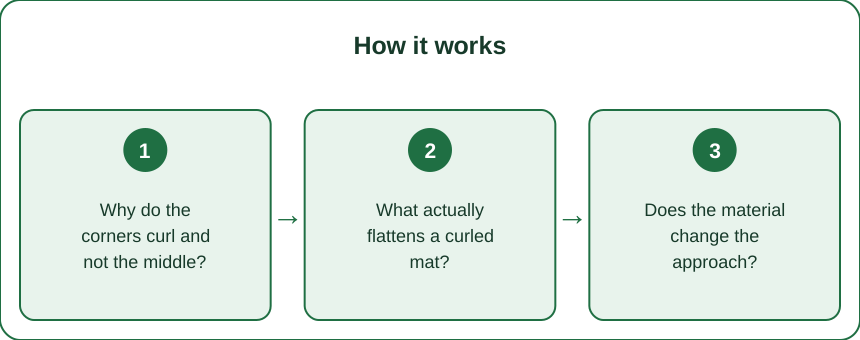
Why do the corners curl and not the middle?
Because rolling puts the material under a bending stress that is unevenly distributed.
When you roll a mat, the outer surface is stretched and the inner surface is compressed. Left in that state for days, polymers undergo a slow deformation called creep — the material gradually accepts the bent shape as its new resting shape rather than springing back.
Corners are worst for two reasons. They are at the free edge of the roll, so there is no adjacent material holding them in place, and they typically end up at the tightest part of the roll where the bend radius is smallest.
Roll direction determines which corners curl. If you always roll from the same end with the top surface out, the same corners curl every time. This is why the problem is so consistent for any given person.
Heat accelerates it dramatically. A mat rolled tight in a hot car trunk in August will take a set in a day that would take a month in a cool closet. Late summer is peak curling season for exactly this reason.
What actually flattens a curled mat?
In order of effectiveness and gentleness:
1. Reverse roll. Roll the mat the opposite direction — tightly, with the previously outer surface now inside — and leave it for 24 hours. This applies an opposing stress and works on most materials. It is free, it takes ten seconds, and it fixes a majority of cases.
2. Store it flat under weight. Lay the mat out and put books or a heavy object on the curled corners overnight. Slower, but works well combined with the reverse roll.
3. Gentle warmth, material permitting. For PVC and TPE mats, 20 minutes of indirect sun makes the polymer more pliable, and weighting it flat while it cools sets the new shape. Indirect only — direct summer sun degrades most mat materials and can make surfaces brittle.
4. Hang it. Over a towel rail, a closet rod, or a mat hanger. Gravity does the work continuously and the mat is never stored bent.
What not to do: no hair dryers, no ironing, no hot water. Concentrated heat deforms and delaminates mat surfaces permanently, and a heat-damaged mat has a slick spot forever.
Does the material change the approach?
Substantially, and using the wrong method on the wrong material is how mats get ruined.
Natural rubber is the most responsive. It relaxes readily with warmth and reverse rolling, often within hours. It is also the most sensitive to direct sunlight — UV degrades rubber and makes it crumbly at the edges. Warmth yes, sun no.
PVC is the most stubborn and the most durable. It takes longest to flatten and tolerates the most aggressive treatment. Indirect sun plus overnight weighting is the standard approach.
TPE sits in the middle and responds well to reverse rolling alone. It is also the lightest material, which means it is the most prone to corner lift during practice even when not curled.
Open-cell polyurethane top layers — the grippy surface on many premium mats — should never be sun-treated or heated. The top layer can separate from the base, and that is unrepairable. Reverse roll and flat storage only.
Cork-topped mats curl less than most because cork is dimensionally stable, but the backing still creeps. Treat according to the backing material, usually rubber.
Check the manufacturer guidance before applying heat to anything. A five-minute look prevents a permanent mistake.
Myth vs Fact: Mat Storage
Myth: Rolling tighter prevents curling. Fact: The opposite. A tighter roll means a smaller bend radius and more creep. If you must roll, roll loosely.
Myth: Rolling with the top surface in protects the grip surface. Fact: It protects the surface from dust but puts the bottom under tension, and it is the reason many people’s mats curl downward at the edges, which is worse for tripping than curling up.
Myth: A curled mat means it is cheap. Fact: Expensive mats curl too, and premium PU-topped mats are among the fussiest. Curling is a storage outcome, not a quality signal.
Myth: Weighting a mat with a heavy object for an hour is enough. Fact: Creep is slow in both directions. Overnight is the realistic minimum, and multiple nights for a mat that has been rolled for months.
Myth: Once curled, always curled. Fact: Most mats recover fully with reverse rolling and flat storage. The ones that do not are usually heat-damaged from a car or a radiator, which is a different failure entirely.
Myth: A mat strap causes curling. Fact: A strap does not cause the bend, but it does hold the roll tight, which accelerates it. Loosen the strap for storage.
FAQ: Mat Curling Questions, Answered
How should I store my mat day to day?
Flat under a bed or hanging over a rod are both better than rolled. If you must roll, roll loosely, alternate direction each time, and never store it in a hot car. If you keep it in a bag, take it out at home.
Will a heavier mat curl less?
Generally yes. Mass helps a corner stay down during practice, and thicker mats resist creep better. That is part of why lightweight travel mats curl the most — the trade-off for portability.
My mat curls during practice even though it lies flat at first. Why?
Usually because the corner lifts when you step near the edge, then heat and moisture from your body help it hold that shape. A mat that lies genuinely flat at the start rarely does this, so it is usually a residual curl that was not fully resolved.
Is a curled corner actually dangerous?
It is a real trip risk in standing sequences and lunges, and it is a persistent distraction. It is not worth practicing around for weeks when 24 hours of reverse rolling usually solves it.
Should I just buy a new mat?
Not until you have tried a week of reverse rolling and flat storage. Most mats sold as unfixable were simply never stored flat.
TL;DR:
- Curling comes from creep — the material accepting the rolled shape — and it is worst at corners and worst in heat.
- Reverse roll for 24 hours first; it fixes most cases for free.
- Store flat or hanging, never tightly rolled, and never in a hot car.
- Indirect warmth plus overnight weighting works for PVC and TPE; never heat a PU-topped or rubber mat in direct sun.
- Alternate roll direction if you have to roll, and loosen the strap for storage.
This is one of those problems that feels like the mat’s fault and is almost entirely a storage habit. Change where it lives between practices and the corners stop being something you notice.
See It in Motion
Seen here: UPF 50+ Racerback Yoga Tank Top — shop it on bubblelime.com
Keep Reading
This article is for general informational and styling purposes only. Fit, sizing, and product availability may vary.