Cold Floors Change How Your Mat Performs - and How Your Body Feels
Quick Answer: Mat materials stiffen as temperature drops, which reduces both cushioning and surface grip, and a cold floor pulls heat out of your body faster than a warm one - so you are colder, stiffer, and on a harder surface simultaneously. Insulate underneath the mat and warm up longer. A rug or blanket under the mat changes more than a new mat would.
Your mat did not get worse over the winter.
It got colder, and so did you, and both of those change what happens on the floor.

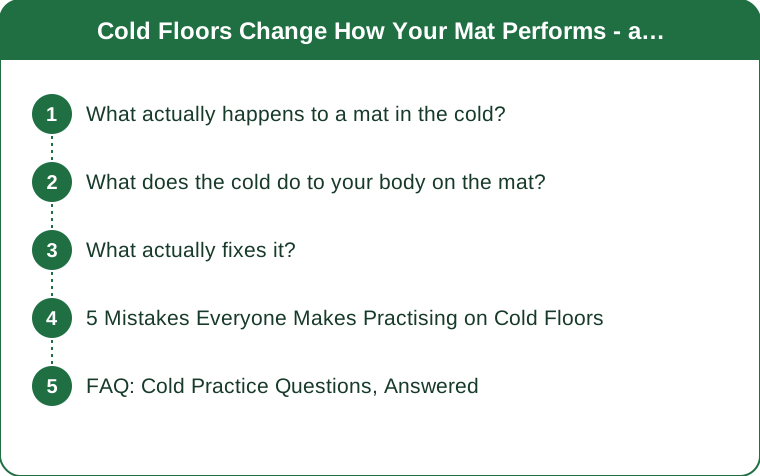
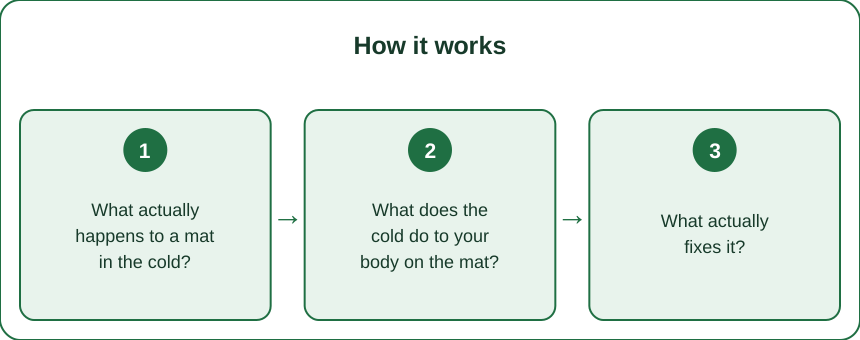
What actually happens to a mat in the cold?
The material properties change, and you feel all of them at once.
Most mat materials stiffen as they cool. Rubber, TPE, and PVC all become firmer and less compliant at lower temperatures, which directly reduces cushioning. A cold mat is a harder mat, measurably.
Grip drops with stiffness. Surface grip depends partly on the material deforming slightly to conform to your hand and foot, and a stiffer surface conforms less. Natural rubber mats are particularly noticeable in this respect, because they are the grippiest when warm.
Cold floors pull heat out of the mat continuously. A thin mat on a cold tile or concrete floor never warms up, because the floor is a large heat sink underneath it. The mat cannot reach room temperature without insulation between it and the floor.
Condensation can form in some conditions. A cold surface in a humid room can develop a slight film of moisture, which is exactly what you do not want under your hands. This is worst in basements and garages in autumn.
Thicker mats insulate better but cushion unpredictably. Thickness helps against a cold floor and can reduce stability in balance work. The trade-off is real and worth deciding deliberately rather than by accident.
And the mat takes time to warm up. Rolling it out five minutes before practising is not enough on a cold floor. Twenty minutes in a warm room, or insulation underneath, makes a genuine difference.
What does the cold do to your body on the mat?
It changes both comfort and how the practice should be structured.
Cold tissue is stiffer and less compliant. Muscles and connective tissue move less freely at lower temperatures, which reduces range of motion and makes everything feel harder. This is not a loss of flexibility, it is a temporary temperature effect.
Contact points get cold fastest. Hands, feet, knees, and any part of you resting on the mat lose heat directly to it, and cold hands grip less well. This is the practical problem rather than an abstract comfort issue.
A longer warm-up becomes genuinely necessary. The warm-up that worked in July is insufficient when you start ten degrees colder. Double the warm-up time for cold-weather practice, particularly before any deep stretching.
Long holds are where the cold bites. Yin, restorative, and any practice with sustained stillness generates almost no heat, so you cool progressively through the session. Layers and blankets matter most in exactly the practices where people wear the least.
Deep stretching in a cold body carries more risk. Cold tissue tolerates less range, and pushing into a stretch that felt fine in a warm room is where strains happen. Warm first, stretch second - and any sharp or persistent pain is worth having looked at. This is general information, not medical advice.
And your practice will simply feel worse for the first ten minutes. That is normal, temporary, and not a reason to conclude anything about your progress. Judge the session at minute fifteen, not minute two.

What actually fixes it?
Insulate, warm, and adjust the sequence - in that order.
Put something under the mat. A rug, a folded blanket, a foam tile, or a second mat. This is the highest-value change by a wide margin - it stops the floor draining heat and restores most of the cushioning.
Move the practice off the coldest surface. Concrete, tile, and basement floors are dramatically colder than carpet on an upper floor. Changing rooms is free and often solves everything.
Warm the room before, not during. A room brought up to temperature twenty minutes ahead lets the mat and the floor warm too. Heating during practice warms the air and leaves the floor cold.
Wear layers you can shed. Start with more than you need and remove as you warm. Long sleeves for the warm-up is the standard approach and it works.
Consider socks and a towel for long-hold practices. Grip socks maintain traction while keeping feet warm, and a towel over you during holds retains a surprising amount of heat. Yin in autumn needs a blanket, not more willpower.
And restructure the sequence. Front-load movement and save deep stretching for the second half, when you are actually warm. Sequence order matters more in cold weather than at any other time of year.
5 Mistakes Everyone Makes Practising on Cold Floors
Rolling the mat out onto bare concrete or tile. The floor drains heat from the mat continuously, and no mat is thick enough to overcome that alone. Something underneath is the fix, not something thicker.
Keeping the summer warm-up. Ten degrees colder means considerably more warm-up time before any deep work. This is the mistake with actual injury consequences, and it is the most common one.
Buying a new mat to fix a grip problem. Cold grip loss affects every material to some degree, and the new mat will do the same thing in the same room. Warm the space first before concluding the mat has failed.
Dressing for the middle of the practice. Dressing for how warm you will be at minute twenty means being cold for the first twenty. Layers you remove solve this in both directions.
Practising yin in what you would wear for vinyasa. Long stillness generates no heat, and you cool steadily through the session. The stiller the practice, the warmer the clothing - which is exactly backwards from how people dress.
And the bonus mistake: storing the mat somewhere cold. A mat kept in a garage or unheated room starts every session cold and takes the whole practice to recover. Store it in a warm room and it starts warm.
FAQ: Cold Practice Questions, Answered
Does a thicker mat solve the cold floor problem?
Partly, and insulation underneath does it better. A rug under a normal mat outperforms a thicker mat on bare concrete, and costs nothing if you already own one.
Why does my mat feel slippery in cold weather?
Because stiffer material conforms less to your hands, and cold rooms can produce slight surface moisture. Warming the mat and the room restores most of it - natural rubber recovers particularly noticeably.
Should I practise less deeply in cold weather?
Early in the session, yes. Warm up longer and save the deep work for the second half, when your tissue temperature has actually risen.
TL;DR:
- Mat materials stiffen when cold, which reduces cushioning and grip at the same time.
- A cold floor drains heat continuously - the mat never reaches room temperature without insulation.
- Put a rug or blanket under the mat - the single highest-value change, and usually free.
- Double the warm-up and restructure the sequence, saving deep stretching for the second half.
- The stiller the practice, the warmer you need to dress - yin needs a blanket, not more willpower.
Before your next autumn practice, fold a blanket under your mat and warm the room twenty minutes ahead. Same mat, and it will feel like the one you had in July.
See It in Motion
Seen here: Racerback Tank Top - White — shop similar styles on bubblelime.com
Keep Reading
This article is for general informational and styling purposes only. Fit, sizing, and product availability may vary.