Choosing a Yoga Mat When You Have Downstairs Neighbors
Quick Answer: A thicker mat alone will not solve apartment noise, because the problem is impact noise travelling through the building structure rather than sound through the air. What works is a layered stack - a dense rug or carpet tile, an interlocking foam or rubber underlay of at least 10 mm, and your normal mat on top - plus changing the movements that generate impact. Jumping is what your neighbours hear; stepping is not. Expect a layered stack plus stepping instead of jumping to remove almost all of the complaint.

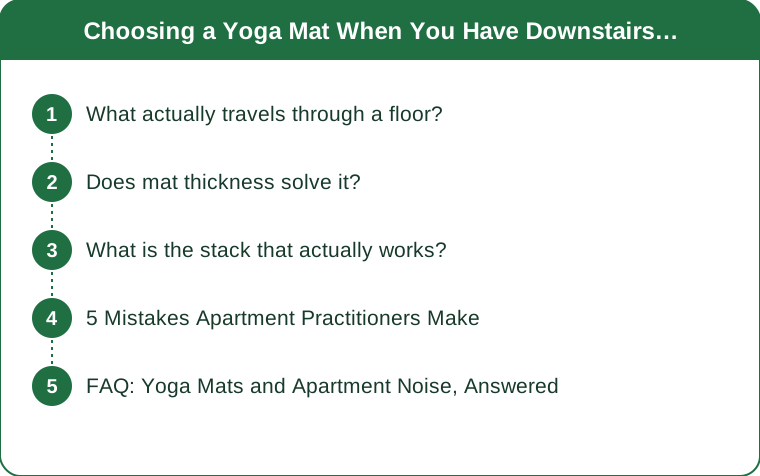
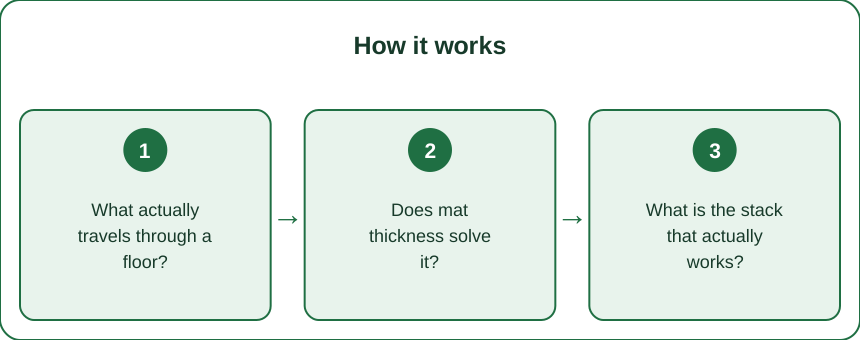
What actually travels through a floor?
There are two different kinds of noise and only one of them is your problem. Airborne noise - music, voices - travels through the air and is blocked by mass. Impact noise travels through the structure itself, and that is what a downstairs neighbour hears from a workout.
Impact noise is generated by force applied to the floor. A jump landing, a dropped weight, a heel striking down - each sends a vibration into the joists that continues through the building.
Mats are designed for cushioning your joints, not for isolating a building. A 4 mm to 6 mm mat has almost no acoustic function and was never intended to have one.
Softness is not the same as damping. A soft foam compresses and rebounds, which is comfortable but transmits impact energy onwards. Density and mass are what absorb it.
Older buildings transmit far more. Timber joist floors carry impact readily, while a concrete slab is dramatically better - which is why identical routines produce complaints in one building and none in another.
And low frequencies travel furthest. The thud of a landing is exactly the frequency that carries through structure, which is why your neighbour hears the jumps and not the breathing.
Does mat thickness solve it?
Going from 5 mm to 8 mm makes very little acoustic difference. It helps your knees and does almost nothing for the floor, which is the single most common misunderstanding here.
Beyond about 10 mm, thick mats create a new problem. They become unstable in standing balance poses, so you trade one issue for another and usually go back.
Material matters more than thickness. Dense natural rubber outperforms soft PVC foam of the same depth, because mass and internal damping are what absorb impact energy.
Two mats stacked beat one thick mat. The interface between two layers disrupts vibration transmission in a way a single homogeneous slab does not - and it costs nothing if you already own an old mat.
But the practice is what governs the outcome. A soft, controlled step down from plank generates a fraction of the impact of a jump back, and no flooring purchase competes with that change.
And carpet already does a lot. If you have carpet with underlay, most of your impact problem is already handled - the remaining issue is usually jumping and dropped equipment.

What is the stack that actually works?
Layer one: a dense rug or carpet tiles. This adds mass and a decoupling layer directly against the floor, and it is the layer most people skip.
Layer two: interlocking foam or rubber tiles, 10 mm or more. High density EVA or rubber gym tiles are the workhorse - they are cheap, they store flat, and they are the biggest single improvement available.
Layer three: your normal mat. You keep the grip and the practice surface you already like, and you are not asking it to do a job it was not built for.
For dropped weights, add a dedicated rubber section. A 20 mm rubber gym tile under a small lifting area solves the loudest single event in most home workouts.
Keep the total stack under roughly 25 mm. Beyond that, balance genuinely suffers in standing poses and the practice degrades.
Position matters too. Practising near a load-bearing wall transmits less than in the middle of a floor span, where the deflection is greatest.
And test it with a phone. Have someone stand below with a sound meter app while you do your usual routine before and after. It converts an anxiety into a number.
5 Mistakes Apartment Practitioners Make
1. Buying one very thick mat and expecting silence. Thickness is joint cushioning, not acoustic isolation. A 10 mm mat alone changes very little downstairs.
2. Ignoring the time of day entirely. A 6am jumping routine is a different social event from the same routine at 6pm, regardless of your flooring. Save impact work for daytime hours.
3. Keeping the jumps. Stepping back to plank instead of jumping removes the majority of the impact noise for free, and costs almost nothing in training effect.
4. Forgetting the equipment. A dropped dumbbell is louder than an entire hour of flow. Set weights down deliberately and keep a rubber tile where they land.
5. Never asking the neighbour. People assume the worst in both directions. A single conversation frequently reveals they hear nothing at all - or tells you exactly which movement is the problem.
The pattern is solving it purely by purchase. The cheapest and most effective fixes are behavioural - step instead of jump, move impact work to daytime, put weights down rather than dropping them - and the third one surprises people who have already spent money on flooring.
FAQ: Yoga Mats and Apartment Noise, Answered
Will a thicker yoga mat stop noise downstairs?
Barely. Impact noise travels through the building structure, and mats are designed for joint cushioning rather than acoustic isolation. Layering is what works.
What is the best setup for an upstairs apartment?
A dense rug or carpet tiles, then interlocking foam or rubber tiles of 10 mm or more, then your normal mat on top. Keep the total under about 25 mm so balance poses still work.
Are two thin mats better than one thick one?
Usually yes. The interface between two layers disrupts vibration transmission in a way a single thick slab does not - and you probably already own an old mat.
What material is quietest?
Dense natural rubber. Mass and internal damping absorb impact energy, whereas soft PVC foam compresses and rebounds, passing the energy onwards.
Do I need to stop jumping?
Stepping back to plank instead of jumping removes most of the impact noise at almost no cost to the workout. It is the single most effective change available.
What about dropped weights?
A 20 mm rubber gym tile in the area where weights land solves the loudest event in most home workouts. Setting weights down deliberately handles the rest.
How do I know if it is actually a problem?
Ask, or have someone stand below with a sound meter app while you run your usual routine. Most people are worrying about considerably more than their neighbour can hear.
TL;DR:
- Impact noise travels through structure, not air. That is why a thicker mat alone changes almost nothing.
- Layer instead: dense rug or carpet tiles, then 10 mm+ interlocking foam or rubber, then your usual mat.
- Two mats stacked beat one thick mat - the interface disrupts vibration transmission.
- Dense rubber outperforms soft foam at the same thickness. Mass and damping absorb; softness rebounds.
- Keep the total stack under about 25 mm or standing balance poses suffer.
- Step, do not jump. The single most effective change, and it is free.
- A dropped dumbbell is louder than an hour of flow - keep a 20 mm rubber tile where weights land.
- Ask the neighbour, or measure with a phone app. Most people are worrying about more than is actually audible.
See It in Motion
Seen here: Round Neck Long Sleeve Athletic T-Shirt — shop it on bubblelime.com
Keep Reading
This article is for general informational and styling purposes only. Fit, sizing, and product availability may vary.